 Play Six Weeks
One small word in a drill result
If I owned shares in a company that had just drilled 152.5 metres grading 8.83 grams of gold per tonne, I’d probably remember those two numbers. Looking at Imperial Metals’ drill table for Red Chris, the word I’d want to remember is including.
In 2009, Imperial drilled hole RC09-350 into the East Zone. Here are two rows from the company’s assay summary. You can find the hole by number in the original drill table.
| Hole RC09-350 | From | To | Length | Gold grade |
|---|---|---|---|---|
| Reported interval | 530.0 m | 962.5 m | 432.5 m | 3.80 g/t |
| Including | 540.0 m | 692.5 m | 152.5 m | 8.83 g/t |
Cover the second row for a moment. Across 432.5 metres, the hole averaged 3.80 grams per tonne. Now uncover it. Those richer 152.5 metres are already inside that average.
What did the other 280 metres average?
Using the published lengths and rounded grades, I get about 1.06 grams per tonne. That’s the part I’d pencil into the margin. And before I pictured 280 metres of uniform rock, I’d look at the depths again. Ten of those metres came before the rich interval. The other 270 came after. I’d want to see their assays separately before saying what happened to the grade farther down.
That’s the kind of reading I’m building into the geology course in Vein & Vice. The syllabus grew out of years of Rule Classroom bootcamps, geology books and afternoons spent working through mining reports like this one.
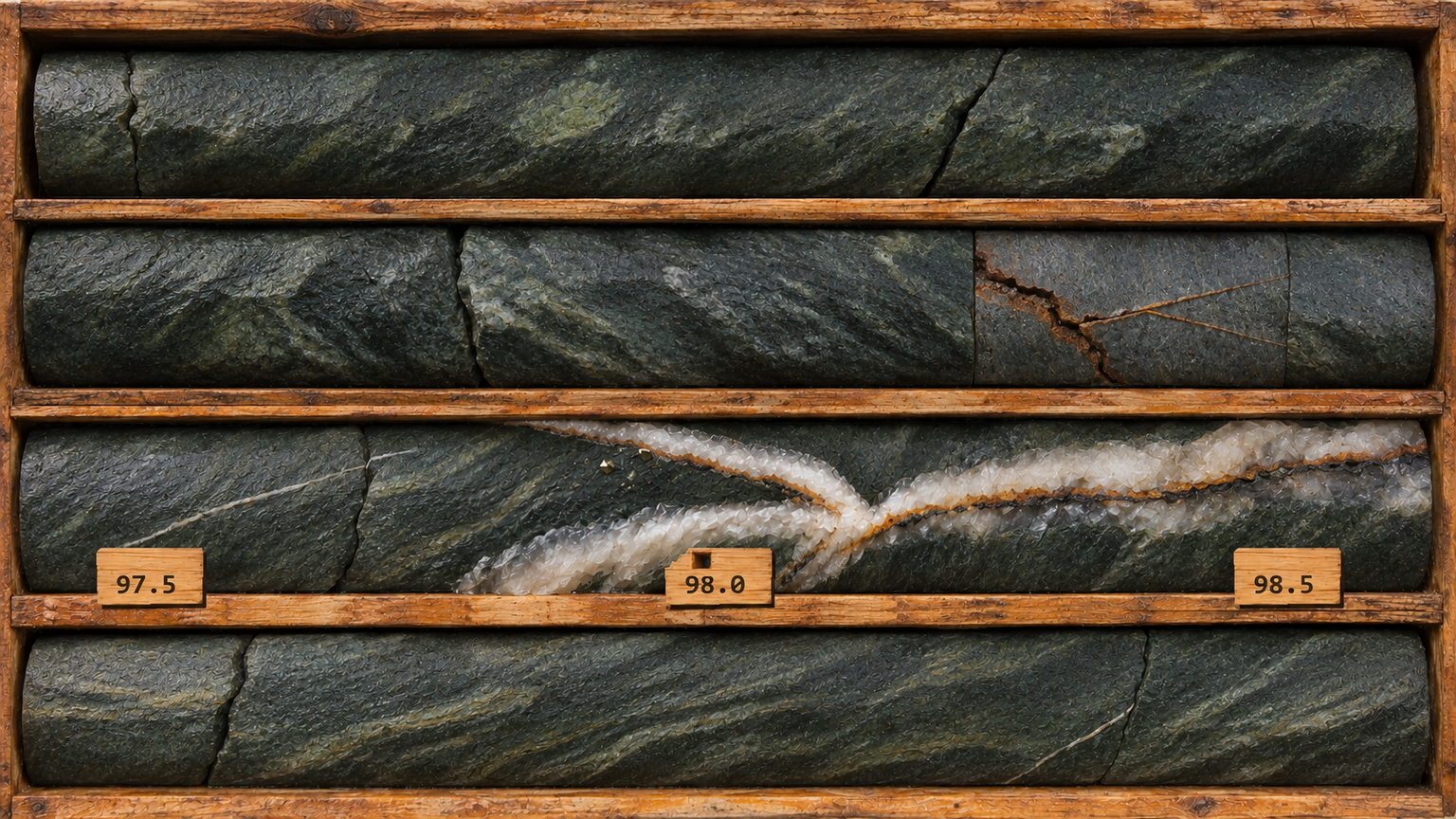
At Paula’s bench in the game, someone wants you to sign a sentence saying the gold gets richer with depth. This time all you have is a photograph and a core tray. What would you be willing to put in the minutes?
Take a seat at Paula’s bench in Six Weeks, the free desktop chapter.